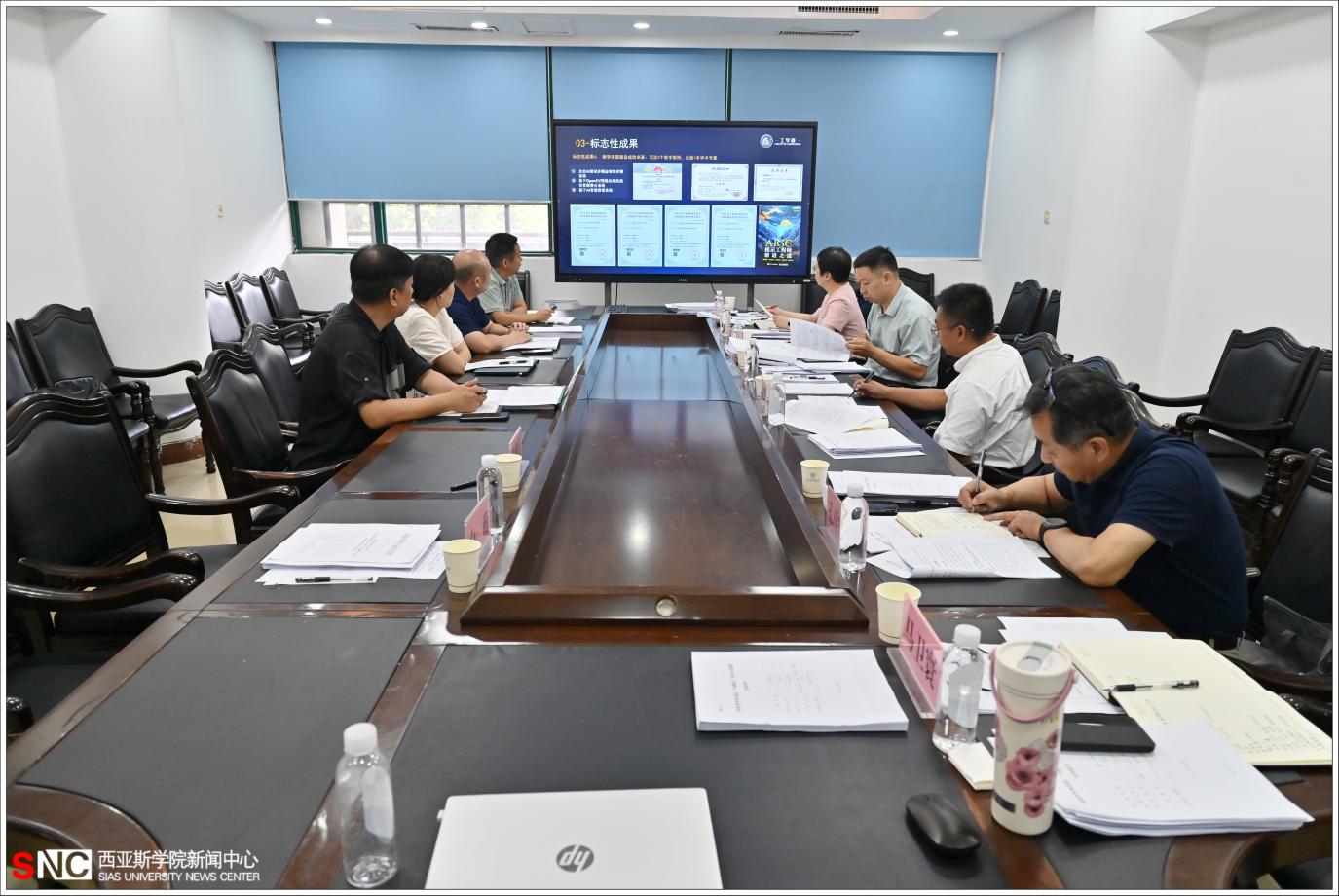

On the morning of June 26, our university held a review meeting for the 2026 new undergraduate program applications in the conference room on the 7th floor of the administrative building. The meeting was chaired by Vice President Zhao Yuxin, with participants including staff from the Academic Affairs Office, relevant schools, and leaders responsible for each proposed program.

Chen Jing, Deputy Director of the Academic Affairs Office, provided a detailed overview of the meeting agenda and briefly introduced the distribution of new program offerings, as well as their intended training objectives and employment directions. Representatives from seven proposed majors, including Emergency Management, Digital Trade, and Business Artificial Intelligence, presented their reports in turn, focusing on the necessity and feasibility of program establishment, talent training plans, and basic conditions for running the programs.
The expert panel reviewed the presentations and application materials, offering specific suggestions for improvement in areas such as curriculum design, faculty development, and the refinement of distinctive program features. In addition, leaders responsible for four newly planned programs for formal application in 2026 also attended the meeting and submitted relevant supporting documentation.

Vice President Zhao Yuxin emphasized that the application for new undergraduate programs is of great significance for optimizing the disciplinary structure and promoting high-quality development. He urged the Academic Affairs Office and relevant schools to attach great importance to the work, closely align with local economic and social development needs, and refine the application documents based on expert feedback. He stressed the importance of promoting development through evaluation and optimization through review, ensuring the high-standard and high-quality completion of the application process.
The meeting represents an important initiative for the university to closely align with regional economic and social needs and actively adapt to the changes of the digital-intelligent era. It will also help optimize the university’s disciplinary layout, promote the upgrading of traditional majors, and foster emerging interdisciplinary fields, injecting new momentum into improving talent cultivation quality and enhancing the university’s capacity to serve society.